


Shrewsbury
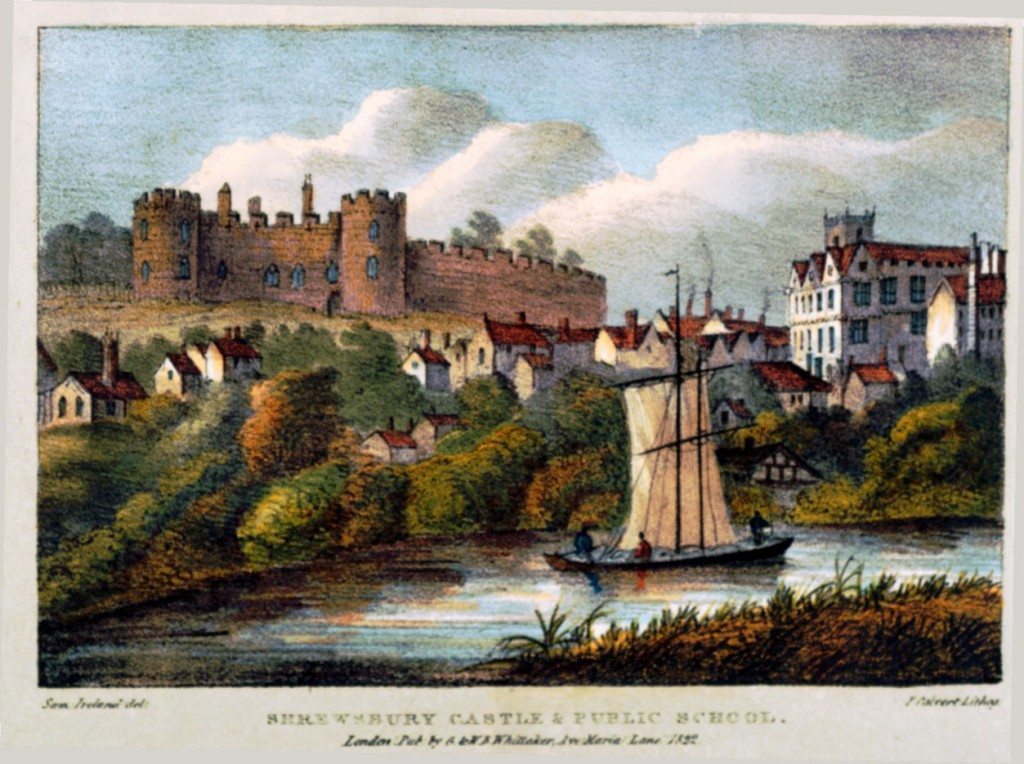
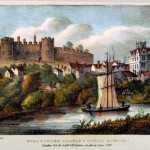
Image: Shrewsbury Castle and Public School. As one of the most important towns on the Severn, Shrewsbury was a political, cultural and economic centre for Shropshire and beyond.
“When within two miles of Shrewsbury, the Severn visibly expands, acquiring consequence, and continuing to augment as it approaches the town, which is indebted to its current for a great portion of the trade, commerce and wealth it enjoys.
The lofty spires of the churches, the hospital, and other buildings combined, form, in the distance, a striking picture; and, as the objects become more distinct, the castle and public school particularly attract the notice of approaching strangers.
The population of Shrewsbury appears to be rapidly on the increase: In 1801, the number of inhabitants…was 14,739; in 1811, 18,543. The chief articles in the commerce and manufactures of this town have been, for ages, flannels and Welch webs….The commerce of the town, as well as the general comfort and convenience of its inhabitants, is greatly promoted by the Shropshire, Shrewsbury, and Ellesmere canals.”
Harral, vol.1, p 94-182.
« Previous in this sectionNext in this section »Continue browsing this section
 A Journey down the Severn from Thomas Harral’s Picturesque Views of the River (1824)
 Introduction: the Severn Waterway
 Poetry and Visions of the River Severn
 The Severn and its Origins in Wales
 Newtown to Montgomery
 Powis Castle to Welshpool
 Welshpool to Shrewsbury
 Shrewsbury
 The English Bridge, Shrewsbury
 The Welsh Bridge, Shrewsbury
 Atcham Bridge, Shropshire
 The Wrekin
 Buildwas Bridge and the Severn Earthquake of 1773
 Coalbrookdale and the Ironbridge
 Madeley, Broseley and Lilleshall
 Bridgnorth
 Bridgnorth’s Economy
 Bridgnorth Castle
 Quatford and the nearby Landscape
 Bewdley
 The Wyre Forest
 Stourport
 Stourport Bridge
 Worcester
 Worcester to Upton-on-Severn
 Tewkesbury
 Gloucester
 Gloucester’s Economy and the Severn Trade