


Types of Glass
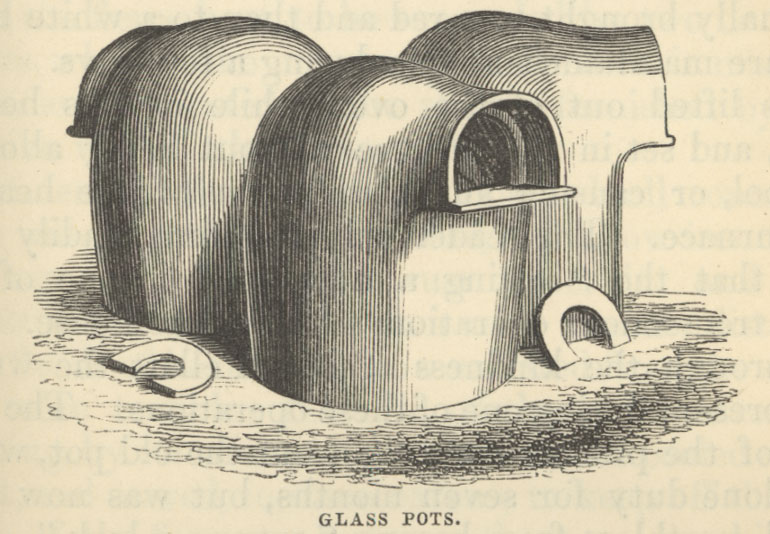
Image: Glass Pots in which the ingredients used in glassmaking were fired. These were made from Stourbridge clay in controlled conditions to ensure that they were free of air bubbles and dried very slowly. The Useful Arts and Manufacturers of Great Britain of Great Britain, Vol. 1 (London, SPCK, 1846?)
Image from: Science, Technology and Management, Birmingham Central Library
The three types of glass that Chances produced were crown, plate or sheet glass and flint glass. The bases for all three were silica and a metallic oxide. The proportions of ingredients varied according to the kind of glass made and the individual practice of each glass producer, who guarded their recipes carefully. Generally the ingredients and proportions were as follows:
- Crown glass: 63 % white sand, 7 % chalk, 30 % soda
- Plate glass: 55 % white sand, 35 % soda, 8 % soda, 2% lime
- Flint glass: 52% white sea sand, 14% potash, 34% oxide of lead
The glass was produced in cone-shaped glass houses with wide open-top chimneys. Inside there was a central furnace surrounded by six to eight pots made of Stourbridge clay. Raw ingredients were placed into these pots and heated and mixed until the “metal” fused into a soft mass. The exhibition The Smethwick Glass Works of Chance Brothers, West Midlands (Theme: Industry and Innovation) provides a further insight into manufacturing processes.
« Previous in this sectionNext in this section »Continue browsing this section
 The Infinite Uses of Glass: Chance Brothers, Glassmakers of Smethwick
 Chance Brothers and Company
 The Arrival of Expert Workers
 The Chemical Works
 Types of Glass
 Crown Glass
 Plate or Sheet Glass
 Flint Glass
 New Technology
 Glazing the Crystal Palace
 Glazing the Crystal Palace
 Lighthouse Production
 Lighthouse Production
 Lighthouse Production
 Lighthouse Production
 Company Philanthropic Activity
 Relations between Workers and the Company
 French and Belgian Workers
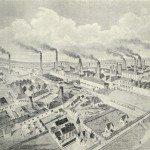 Description of the Glassworks
 Description of the Glassworks