

Derby Porcelain: André Planche and William Duesbury
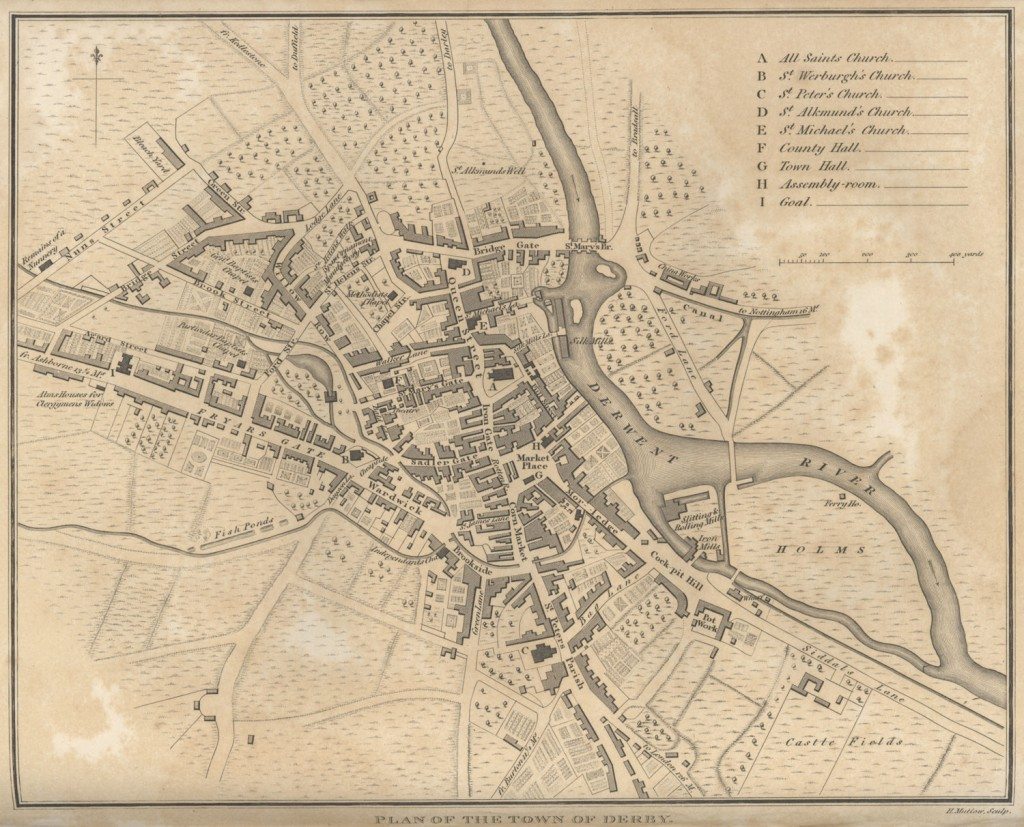
Image: Plan of the Town of Derby showing the silk mill and china works in the top right-hand portion of the map. Rev Daniel Lysons and Samuel Lysons, Magna Britannia, being a Concise Topographical Account of the Several Counties of Great Britain, Volume the Fifth containing Derbyshire, (London, T Cadell and W Davies, 1817)
Image from: Local Studies and History, Birmingham Central Library
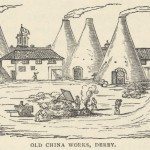
Making porcelain at Derby began as early as the 1730s, but the start of the Derby factory is associated with the “china maker” André Planche (1727-1805), the son of a Huguenot immigrant. Planche established his first china workshop in 1748. Little is known about his life, but his artistic talent is to be seen in several figures and jugs which are preserved at Derby Museum and Art Gallery, and at the Victoria & Albert Museum, London.
In 1756, Planche entered into partnership with William Duesbury, (1725-1786), an enameller from Staffordshire, who became manager of the factory in Nottingham Road. Under his leadership the factory started to produce china of outstanding quality. Unlike other local establishments, the Derby factory made little tableware and almost entirely produced ornamental vases and figurines, which were strongly influenced by continental porcelain, mainly of Sèvres and Meissen. Duesbury even proudly claimed to have created at Derby a “second Meissen”. Special features of Derby porcelain were its intricate shapes, rich polychrome painting and sophisticated decoration, which would later be also enriched by generous gilding.
Being well aware of the competition, Duesbury purchased several potteries near London, including the famous Bow and Chelsea Works, and eventually closed them down. Craftsmen from Chelsea were brought to Derby.
In 1775, George III authorised the use of the crown in the factory mark. In 1890, Queen Victoria would confirm the prestige of the Derby factory by granting it the use of the Royal Arms and the title “Royal”.
« Previous in this sectionNext in this section »Continue browsing this section
 Derby Porcelain in the 18th and early 19th centuries
 Derby Porcelain: André Planche and William Duesbury
 Derby Porcelain: William Duesbury II and Robert Bloor
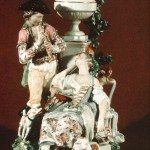 Pastoral Group, c.1770
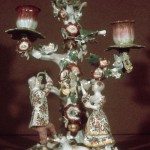 Candelabrum, c. 1755-60
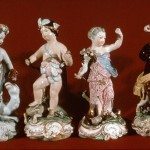 The Four Quarters (Continents), c.1775
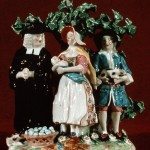 Tithe Pig Group, c.1765-70
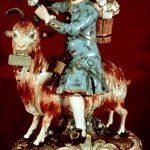 The “Welsh” Tailor, c.1770
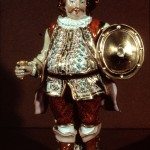 James Quin as Falstaff, c. 1825
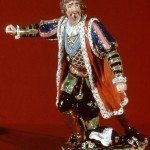 Edmund Kean as Richard III, c.1815
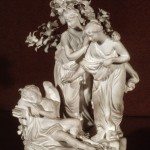 Virgins Awakening Cupid, c.1780
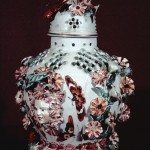 Frill Vase and Cover, c.1760
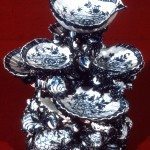 Blue & White Table Centre in two parts, c.1760
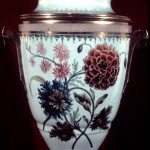 Ice Pail, c.1796-1800
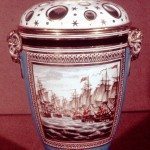 Pot-Pourri, c.1800-1810
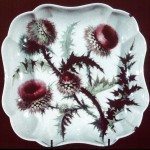 William Pegg’s Thistle Dish, c.1800
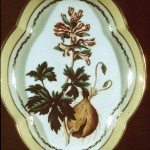 Dish, c.1800
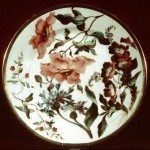 Dessert Plate, c.1813-1820
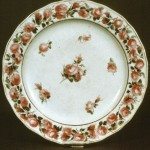 William Billingsley’s Prentice Plate, 1790-1795
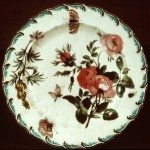 Dessert Dish, c.1790
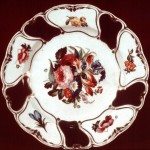 A Dessert Plate from the Trotter Service, c.1825
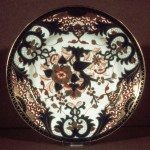 Dessert Plate (Imari)
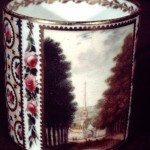 Coffee Can, c.1793-4
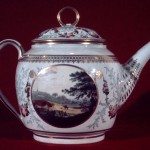 Teapot, c.1795
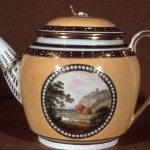 Teapot, c.1795
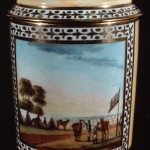 Chocolate Mug with Cover, c.1800