


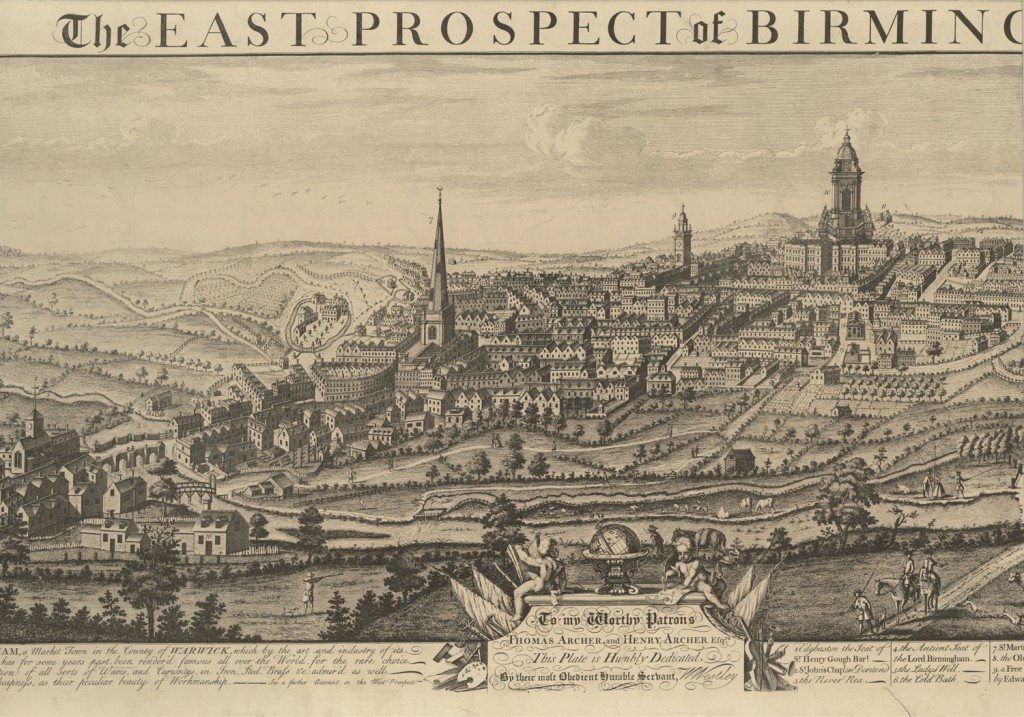
Priestley and Birmingham
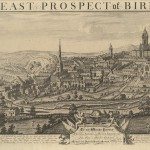
Image: Westley’s East Prospect of Birmingham, published about 1730
Image from: R K Dent, Old and New Birmingham (Birmingham, Houghton and Hammond, 1880)
Birmingham in the eighteenth century was an extraordinarily dynamic and inventive place. Little more than a large industrial village at the start of the century, it was expanding at a faster rate than any other centre of population in England with the possible exception of Sheffield. By the end of the third quarter of the century it had become the third largest town in England and Wales (after London and Bristol). By the century’s end it boasted nearly 74,000 inhabitants, although the population peak may have occurred a decade earlier. It was a manufacturing town, of course; indeed ‘the first manufacturing town in the world’ according to the travel writer Arthur Young 4. Utilitarian hardware was its stock-in-trade, but a switch to ornamental metal goods was under way – buttons, buckles, watch chains, snuff boxes, small brass objects and so forth – much of which was produced for export markets.
4 See E. Hopkins, The Rise of the Manufacturing Town: Birmingham and the Industrial Revolution (Guildford, 1998), p. xiii
« Previous in this sectionNext in this section »Continue browsing this section
 The Life and Times of Dr Joseph Priestley
 Introduction
 Priestley’s Origins
 Priestley’s Education
 Priestley’s Early Career
 Priestley and Lavoisier
 Priestley and Nonconformist Leaders
 Priestley and Birmingham
 Priestley and Birmingham
 Explaining the Priestley Riots
 The Priestley Riots and their Aftermath
 Priestley and America
Conclusion
Priestley and America
Conclusion