


Rural Happiness. To a Friend and Moonlight: in the Country
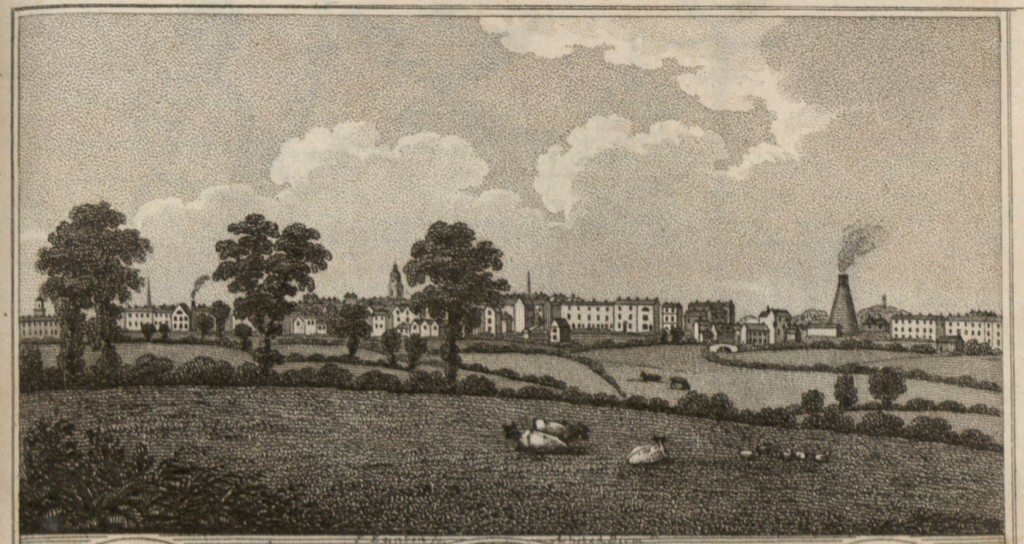
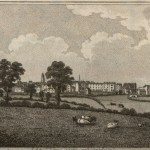
Image: View of Birmingham from Aston Wharf. Bisset’s Magnificent Guide or Grand Copper Plate Directory for the Town of Birmingham (Birmingham, Printed for the Author by R Jabet, 1808)
Birmingham is presented across a series of fields populated by sheep and cows. The most prominent buildings are St Philip’s Church in the centre and the cone of a glass house to the right.
Image from: Local Studies and History, Birmingham Central Library
Rural Happiness. To a Friend
Hail! Fair Abodes of Freedom, Joy, and Peace!
Where Treasure flows, and useful Arts increase, 12
Moonlight: in the Country
…… the hurrying scenes of busy life,
Where sons of riot, waste the midnight hours;
Plung’d in the dang’rous ways of guilt and strife,
…………
‘Mong noise and smoak, or swallow’d up in care,
Fam’d Vulcan’s rustic sons with Bacchus reign.
…………
While copious draughts inflame their growing zeal ……13
These final two extracts are placed together for two main reasons. The first is that William Shenstone, in his role as a ‘Maecenas of the Midlands’, included among the several local minor poets he advised and assisted both Mary Whateley and Joseph Giles, a sometime engraver. Another of his proteges, James Woodhouse, has already been mentioned. Without Shenstone’s patronage and connections, it is probable that none of these three would have had their early volumes of poetry published.
The second reason for placing these two extracts together is that, while both are about Birmingham, the tone and content of each are markedly different from those of the other. Miss Whateley’s lines on Birmingham, from a poem in which she also describes the immediate golden agricultural landscape, are simple, bright and positive about the town and its skills. In contrast, Giles’s description of the town is much darker. He sees ‘sons of riot’ plotting. Indeed, there was rioting in the region several times during the second half of the eighteenth century. The 1760s, for example, saw several outbreaks because of shortages or the high prices of food. The phrases ‘with Bacchus reign’ and ‘copious draughts inflame’ suggest overindulgence and drunkenness. While there were contemporary reports and complaints of drunkenness, it should be remembered that in many areas at this time it was still safer to drink beer than possibly-contaminated water. And in one of his songs, John Freeth wrote in praise of ‘Birmingham Beer’.
The most striking line from Giles is: ‘Fam’d Vulcan’s rustic sons with Bacchus reign’. ‘Reign’ with the Classical god of wine could connote being inebriated and/or powerful. Yet whichever, ‘Fam’d Vulcan’s rustic sons’ makes clear that these are renowned metalworkers, who labour ‘Mong noise and smoak’, as did the ancient smith-god.
Although so different, both Whateley’s and Giles’s descriptions of Birmingham could be true, according to the perspective of each writer.
2 Mary Whateley, Rural Happiness. To a Friend, pages 29-32, Original Poems on Several Occasions, R.& J. Dodsley, London, 1764.
3 Joseph Giles, Moonlight: in the Country, pages 17-21, Miscellaneous Poems on Various Subjects and Occasions, J. Godwin, London, 1771.
« Previous in this sectionContinue browsing this section
 Poetry and the Industrial Revolution in the West Midlands c. 1730-1800
 The Cyclops: Addressed to the Birmingham Artisans, Anonymous
 A Letter from a Mechanick in the busy Town of Birmingham, to Mr. Stayner, a Carver, Statuary, and Architect, in the sleepy Corporation of Warwick
 Answer to Dardanus’s
 Industry and Genius; or, the Origin of Birmingham. A Fable
 Labour and Genius: or, the Mill-stream, and the Cascade. A Fable
 Inland Navigation, An Ode. Humbly Inscribed to The Inhabitants of Birmingham, And Proprietors of the Canal
 Edge-Hill: a Poem, in four Books
 Colebrook Dale
 The Life and Lucubrations of Crispinus Scriblerus
 The Botanic Garden, Erasmus Darwin
 Ramble of the Gods through Birmingham. A Tale, James Bisset
 Rural Happiness. To a Friend and Moonlight: in the Country